

Covered here
Employer duty of care, visit procedure, public-area safety, private visits, a dog that arrives during the visit, withdrawal, near miss, hazard and accident reporting, and first-aid signposting after a bite.
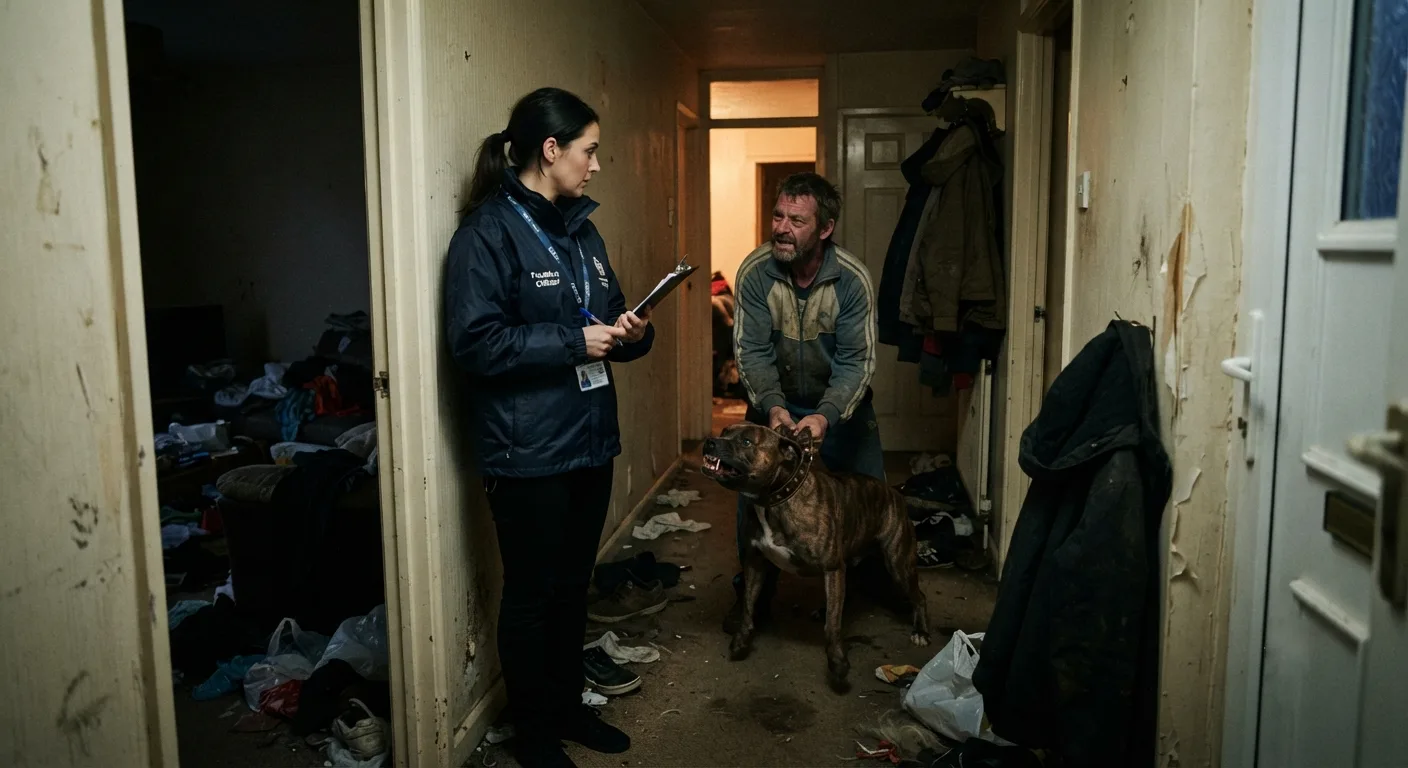
This guide is for people who own the visit system, then for the staff who use it. Typical readers are human resources, housing association and local authority managers, care and support leads, and team leaders writing a procedure.
Shared foundation first: reading a dog, making a withdrawal decision, recording a hazard. Then where the job actually differs.
Local authority specialists and enforcement officers may be there because of the dog or a seizure. Housing, care and trades are trying to do another job in a property where a dog may be present. Kennels staff who hold seized dogs have a separate resource. Do not fold kennels into the housing-officer visit script.
Employer duty of care, visit procedure, public-area safety, private visits, a dog that arrives during the visit, withdrawal, near miss, hazard and accident reporting, and first-aid signposting after a bite.
This is not legal advice. It is not dog handling for visiting staff. It is not personal physical care, veterinary treatment or a medical protocol. It is not a guarantee. It is not banned types only. Any dog can be dangerously out of control. Holding seized dogs in kennels sits on a separate page.
Statutes in more depth sit in the Workplace Safety Legislation Guide. Lone visits belong with the Lone Worker Safety Centre.
Dog-related risk is foreseeable for these roles. It belongs in the organisation's general risk assessment under the Management of Health and Safety at Work Regulations 1999, in lone working arrangements, and in visit procedures. The Health and Safety at Work etc. Act 1974 sets the employer duty of care. That is Safety Solutions Training interpretation of ordinary employer duty. It is not a named dangerous dogs duty in the Act.
Write the policy stack before staff are sent out: visit procedure, refusal to enter, withdrawal, warning markers, incident and near-miss reporting, first aid and medical signposting, lone working, safeguarding where a child or adult at risk is in the home, and information sharing with contractors and trades.
Housing, care and trades work includes occupied homes, rear access, tools, ladders and repeat visits the same day. A procedure that only covers the first knock at the front door will fail the second visit, the side gate, and the contractor who was never told.
Pre-visit questions are a control: how many dogs, where they will be secured, who else will be there, whether anyone may arrive with a dog. Trades and contractors must receive the same warning markers as housing officers. A repairs operative the next morning is the next visitor.
Most of these encounters are lone visits. Link this procedure to the Lone Worker Safety Centre.
This section is short practical awareness, not a statute dump and not legal advice. Use the legislation guide for the map. Name the country you work in.
Under the Dangerous Dogs Act 1991 it is an offence to possess a banned type. Assessment is by physical type, not registered breed or paperwork. The current list includes the pit bull terrier, Japanese tosa, Dogo Argentino, Fila Brasileiro and, in England and Wales from February 2024, the XL Bully type. A dog does not need to have bitten anyone for that possession offence to be relevant.
Section 3 of the same Act deals with a dog that is dangerously out of control. The Anti-social Behaviour, Crime and Policing Act 2014 extended that offence to all places, including the owner's home. GOV.UK, checked 31 August 2026, states that the law applies in public, in a private place such as a neighbour's house or garden, and in the owner's home. It applies to all dogs. Banned type is not the whole risk.
Householder defence (England and Wales)A person is not guilty of the section 3 offence in a householder case. That is where the dog is out of control in or partly in a dwelling, and the other person is, or is believed to be, a trespasser there. Crown Prosecution Service guidance says it does not apply to a postal worker using a letterbox, and does not extend to gardens, driveways or outbuildings. Lawful visitors are not trespassers. Housing officers, care workers and trades are not protected by this defence. Scotland does not use this England and Wales wording.
Exemption scheme changes, 2026 (England and Wales only)The Dangerous Dogs (Exemption Schemes) (England and Wales) (Amendment) Order 2026, statutory instrument (SI) 2026/602, extends to England and Wales only. From 1 July 2026 the third-party public liability insurance condition was removed from Certificates of Exemption. GOV.UK, last updated 1 July 2026, says you do not need that insurance for banned-type dogs, including XL Bully dogs. Removing compulsory insurance does not remove civil liability for harm. Coming into forceFrom 1 November 2026 a new Certificate of Exemption condition will require that an exempted banned-type dog does not come into close contact with a child under 12 in a private place unless an adult over 18 is supervising. That condition is not in force on 31 August 2026. Do not treat it as live criminal law today. It is a condition for exempted banned types, not a duty for all dogs. Close contact is not defined in the Order.
Staff do not decide type on the doorstep. Escalate a suspected banned type, or a dog that has caused injury, to the manager and, where appropriate, the police or a dog warden. Seizure can keep a dog in kennels for months.
Scotland, Northern Ireland and Ireland operate their own frameworks. Do not assume the England and Wales exemption Order applies. Do not use the Employment Rights Act 2025 as the law for dog safety.
Communal halls, landings, streets, parks, garden approaches, vans and gateways are not the same as a private living room. Tactics differ even where the law still applies. A dog that is under some control in a hallway can still cut off the stairs. A dog that comes out as a van door opens can put tools, materials and the operative between the animal and the exit.
Treat every property as unknown until you have visually confirmed otherwise. Dog ownership changes are rarely reported. Shared and multi-occupancy properties often have dogs that never appear on one tenant's record. Phone the occupant where the procedure allows and ask the questions before anyone travels. Do not treat a missing flag as a safe property.
Look and listen before you approach: barking, scratching, a dog at a window, or warning signs. Check the boundary and side access. Knock and step back so you can see the response and retreat. If a dog is audible or visible, ask the resident to secure it in another room and wait until you can see that it is secured. Do not accept a shout from inside as confirmation while you are already stepping in. If the resident will not answer the question, treat that reluctance as information.
Keep a clear route to the exit. Stay side-on rather than square-on to an unfamiliar dog. Avoid sustained staring, sudden gestures, raised voices, or reaching over a dog's head. Do not crouch or offer a hand to sniff if you are concerned, even if the owner invites it. Watch for resource guarding: food, toys, tools, a chair, or a particular person. A dog that goes quiet after growling has not necessarily calmed down. Silence after a clear warning can precede a bite.
Neutral tail. Moving away rather than towards you.
Weight shifted slightly forward. Slow down. Do not push on.
Tail high and rigid or tucked. Lip licking or yawning out of context.
The dog is telling you to stop. Withdraw.
Care visits last longer. The occupant's bond with the dog can make rescheduling harder. Withdrawal still stands.
Operatives often work with their back turned, make noise such as drilling, occupy a room the dog treats as theirs, and return the same day. The same withdrawal rule applies. The warning marker must reach the next trade visit, not only the housing officer.
A friend, relative or other resident may bring a dog in after you have started work. Stop the task. Ask for the dog to be secured outside the working space, or pause the visit. If that does not happen, withdraw. Record it as a near miss or hazard even if there is no bite.
Withdrawal is a correct outcome when control is lost, refused or cannot be confirmed. It is not a failed visit.
Leave calmly. Do not turn your back or run. Do not renegotiate in the doorway. Get to a safe distance, then call it in and record it.
A dog hazard that is not recorded is a hazard the next colleague meets cold. Update the system the same day. Trades and contractors must see it.
Address, date, what you observed (appearance, size, behaviour), whether the dog was secured, and whether the resident disclosed it. Record facts, not temperament guesses.
A lunge, a trapped room, a door opened onto a dog, a visitor arriving with a dog, or an owner who refused to secure. This is a formal record, not an informal note.
After a bite or injury, use the workplace incident route: first aid, medical care, preserve facts while they are fresh, and consider police or dog warden where the dog was dangerously out of control. The Reporting of Injuries, Diseases and Dangerous Occurrences Regulations 2013 may apply, depending on the injury and the work connection. This page is not a decision tool for those Regulations. The responsible person applies the criteria. See the legislation guide and the Health and Safety Executive.
Get away from the dog before paperwork. Then first aid. Puncture wounds carry infection risk. Significant bleeding needs urgent care. Use National Health Service (NHS) or ambulance services as appropriate.
Safety Solutions Training does not treat, stitch or prescribe. This is signposting, not a clinical protocol.
Then complete the workplace report, record facts while they are fresh, and offer welfare support. See post-incident support for staff.
Kennels work is commissioned separately. Handling a seized dog is not the housing-officer syllabus. For kennel staff who receive, house, observe and record dogs already seized, use the Kennels seized dogs resource.
Reading a paragraph about withdrawal is not the same as making that decision with a dog three feet away.
Safety Solutions Training runs Dangerous Dogs Awareness as a half-day or full-day course, shaped to the organisation. It is delivered by recently retired police dog handlers, or police with direct focused dog experience. Training does not replace a risk assessment, a visit procedure or a reporting system. It does not make staff safe around every dog.
Official sources used for this page
First published 24 August 2026. Source check 31 August 2026. Next review 1 November 2026, when the under-12 Certificate of Exemption condition is due to commence, or sooner if Dangerous Dogs Act, exemption or Health and Safety Executive rules change. Not legal advice.