

Best Conflict Management Training for Frontline Staff
The best conflict management training for frontline staff starts by asking staff what risks they face and what concerns them most at work. It uses those real situations to help staff practise spotting early warning signs, de-escalating conflict and deciding when to end an interaction, leave safely or call for help.
We deliver our Conflict Management & Lone Worker Personal Safety Training in-house, either face-to-face or as a live virtual session with a trainer. Both formats give staff time to work through realistic scenarios, practise what to say and get feedback.
How we shape the training with you and your staff
Before delivery, we agree the scope and priorities with the commissioning organisation. We discuss what your staff do, the risks you have identified and the policies and procedures you expect them to follow.
We open every session by asking staff about the risks and concerns they encounter in their own roles. We ask what situations they find difficult, what has happened before and where they are unsure what to do. That discussion helps us decide which examples need more time and which decisions staff would benefit from practising.
We use your organisation's policies and procedures in the exercises. Staff rehearse when to end an interaction, how to raise an alarm, who should respond and what to report afterwards. The aim is to help staff use your procedures confidently and consistently in their day-to-day work.
What the training covers
Early warning signs and de-escalation
A receptionist dealing with an angry visitor faces different decisions from a housing officer on a home visit. We use examples from your team's work so staff can practise recognising changes in tone, language and behaviour. They rehearse how to listen, explain what they can do, set clear boundaries and decide when to stop the conversation and get help.
Workplace violence, aggression and harassment
The Health and Safety Executive defines work-related violence as 'any incident in which a person is abused, threatened or assaulted in circumstances relating to their work'. We discuss what verbal abuse, threats and physical assault can look like in your workplace. We also cover harassment, sexual harassment and sexual assault, including how staff can raise concerns and get support. (Health and Safety Executive guidance on work-related violence)
Employer responsibilities and managing risk
We discuss what the Health and Safety at Work etc. Act 1974 and the Management of Health and Safety at Work Regulations 1999 mean for employers in practice. This includes the duty to protect staff so far as is reasonably practicable, assessing the risks staff face, putting suitable measures in place and making sure staff understand the procedures they are expected to follow. Where the organisation provides them, we also cover the use of lone worker devices, silent or audible alarms at reception desks and in interview rooms, and CCTV on its premises. (Health and Safety at Work etc. Act 1974, section 2 and Management of Health and Safety at Work Regulations 1999, regulation 3)
We also cover the Equality Act 2010 and the duty to prevent sexual harassment introduced by the Worker Protection (Amendment of Equality Act 2010) Act 2023. Since 30 October 2026, the Employment Rights Act 2025 has required employers covered by these provisions to take all reasonable steps to prevent sexual harassment of employees in the course of their employment. The changes also mean an employer must not permit a third party, such as a customer, client or visitor, to harass one of its employees in the course of their employment. The employer is liable if it failed to take all reasonable steps to prevent the harassment. This covers all harassment under the Act, not only sexual harassment. (Equality Act 2010, section 40A, Equality Act 2010, section 40 and Equality Act 2010, section 26)
Lone working, emergency response and dog encounters
Staff work through what to check before a visit or shift, how to keep in touch and what happens if they miss a check-in. Where personal safety devices are provided, we cover when to use them, who responds to an alert and how an emergency is escalated. (Health and Safety Executive guidance on managing the risks of working alone)
We also discuss encounters with potentially aggressive dogs. Staff consider what to ask before a visit, when to ask for a dog to be secured and when to postpone or end the visit. Further guidance is available in our Lone Worker Safety Centre.
Being recorded, online abuse and staff identity
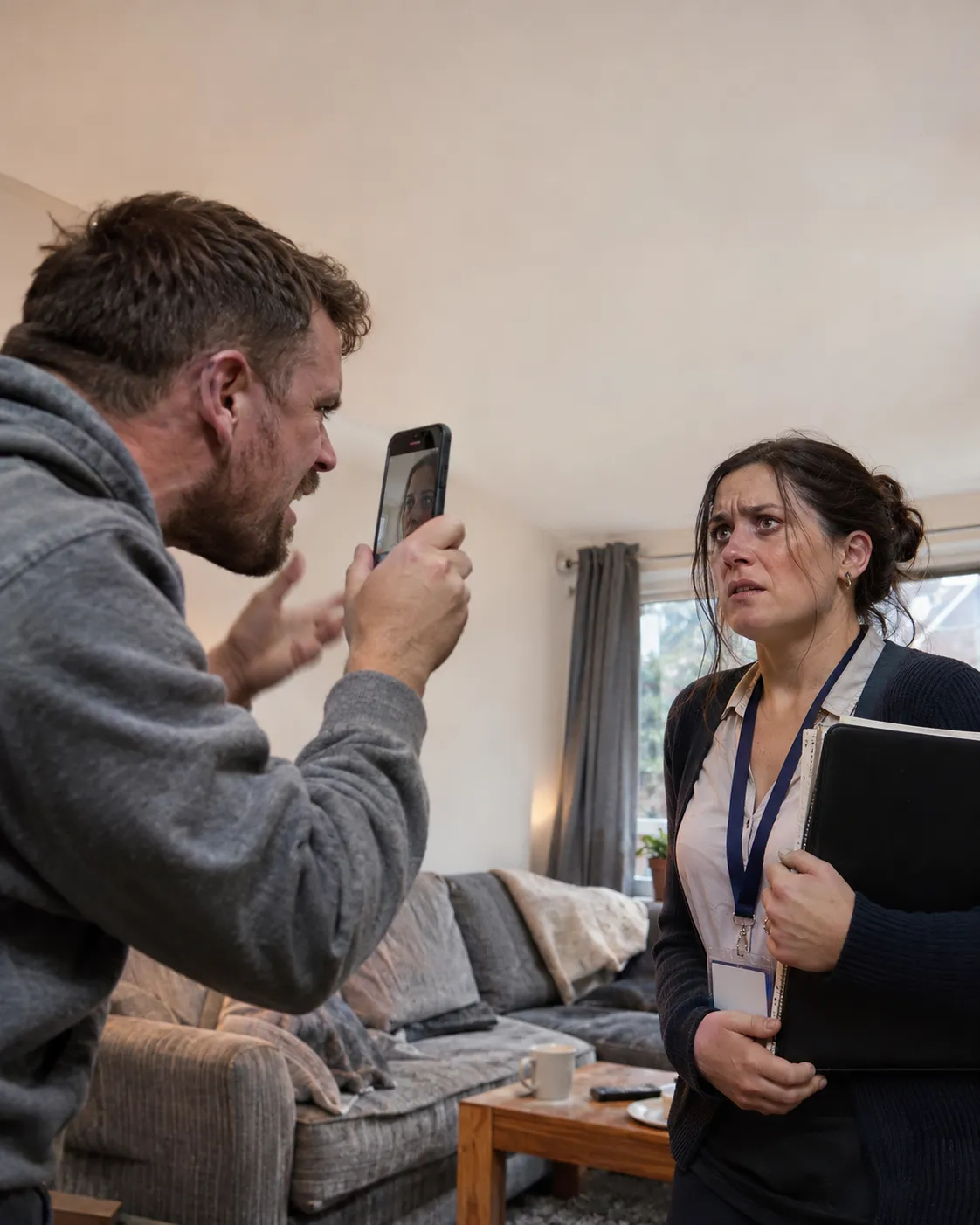
Staff practise what to say and do if someone starts recording them, shares footage online or targets them with abusive or harassing messages. We also look at what someone could find out about a member of staff from a name badge, an email address or signature, or the name shown in Microsoft Teams. Staff consider what they share online, and managers consider how to reduce unnecessary exposure while keeping staff identifiable internally.
Reporting and support afterwards
Staff discuss what to record after an incident or near miss, who to tell and what evidence to keep. We also look at how managers can check on staff, arrange support and decide whether the risk assessment or arrangements for future contact need to change. (Health and Safety Executive guidance on work-related violence)
How the training approaches compare
| Approach | Best use | Strengths | Limits |
|---|---|---|---|
| E-learning only | Induction, basic awareness and refreshers | Staff can learn at their own pace and revisit the material | Limited opportunity for live practice and individual feedback |
| Classroom theory | Explaining policies, responsibilities and reporting procedures | Gives staff a shared understanding and time to ask questions | Staff may have little opportunity to rehearse what they would do |
| Scenario-based face-to-face training | Rehearsing in-person situations | Staff can practise wording, tone, body language, use of space and when to leave | Staff need to attend in the same place |
| Live virtual sessions | Bringing staff from different sites together to work through in-person scenarios | Staff can practise what to say, discuss decisions and get live feedback | Less suited to practising movement and use of physical space |
| Prevention and management of violence and aggression (PMVA) training with physical intervention | Roles where the employer has identified a need for physical intervention skills | Provides supervised practice in the techniques covered | Suitability depends on the role, the risks and the employer's procedures |
Frequently asked questions
How long does the training take?
Our full-day programme typically runs from 9.30 am to 4 pm. This gives staff time to raise their concerns, work through several scenarios and practise applying your procedures.
What is included in the training?
We cover early warning signs, de-escalation, lone working, emergency escalation, reporting and post-incident support. We agree the detail with you beforehand and use the opening discussion to bring staff's own concerns into the session.
Who is the training for?
It is for staff who deal with the public in person, including reception teams, fast-food and retail staff, housing officers and local authority enforcement officers. It also suits staff who visit people at home or work away from immediate support. We offer a separate course for staff who handle challenging or abusive phone calls.
Can we book the session face-to-face or virtually?
Yes, we offer the programme in both formats. Face-to-face training gives staff room to practise body language, movement and leaving a situation. Live virtual training lets teams across different sites rehearse what to say and work through decisions together with a trainer.
How many delegates can attend?
We train up to 15 delegates per session in either format. This gives staff time to take part in the exercises and receive feedback.
Do delegates receive a certificate?
Yes. Each delegate receives a certificate of attendance.
How does this differ from PMVA training with physical intervention?
Our standard programme focuses on early intervention, de-escalation and leaving safely. Basic breakaway skills are available at an additional cost when the commissioning organisation requests them. However, our focus is on conflict management, de-escalation and risk awareness, which reduce the need for escape strategies and lockdowns. We discuss the law on self-defence as a last resort if someone is held against their will, faces an imminent assault or is being assaulted, including what it means for any use of force to be necessary and reasonable in the circumstances as the person honestly believed them to be. This covers the law in England, Wales and Northern Ireland; Scotland has its own law on self-defence. (Criminal Justice and Immigration Act 2008, section 76)
Discuss training for your team
Our trainers are recently retired police officers. We bring more than 30 years of policing and training experience and have worked with more than 400 organisations.
- Start with the risks and concerns your staff face.
- Practise spotting warning signs, de-escalating and knowing when to leave.
- Use your procedures to get help, report incidents and support staff afterwards.
Tell us what your staff do and which situations concern them most. We'll agree what to cover and whether face-to-face or live virtual delivery suits your team.
Discuss your team's training needsThis page summarises the law in Great Britain (England, Wales and Scotland) unless it says otherwise. Northern Ireland has its own health and safety and equality law.
This page is general information, not legal advice. The law can change, so check official sources such as legislation.gov.uk, HSE and the Equality and Human Rights Commission on the day you rely on it. It does not decide liability in any particular case.