

Statutory context
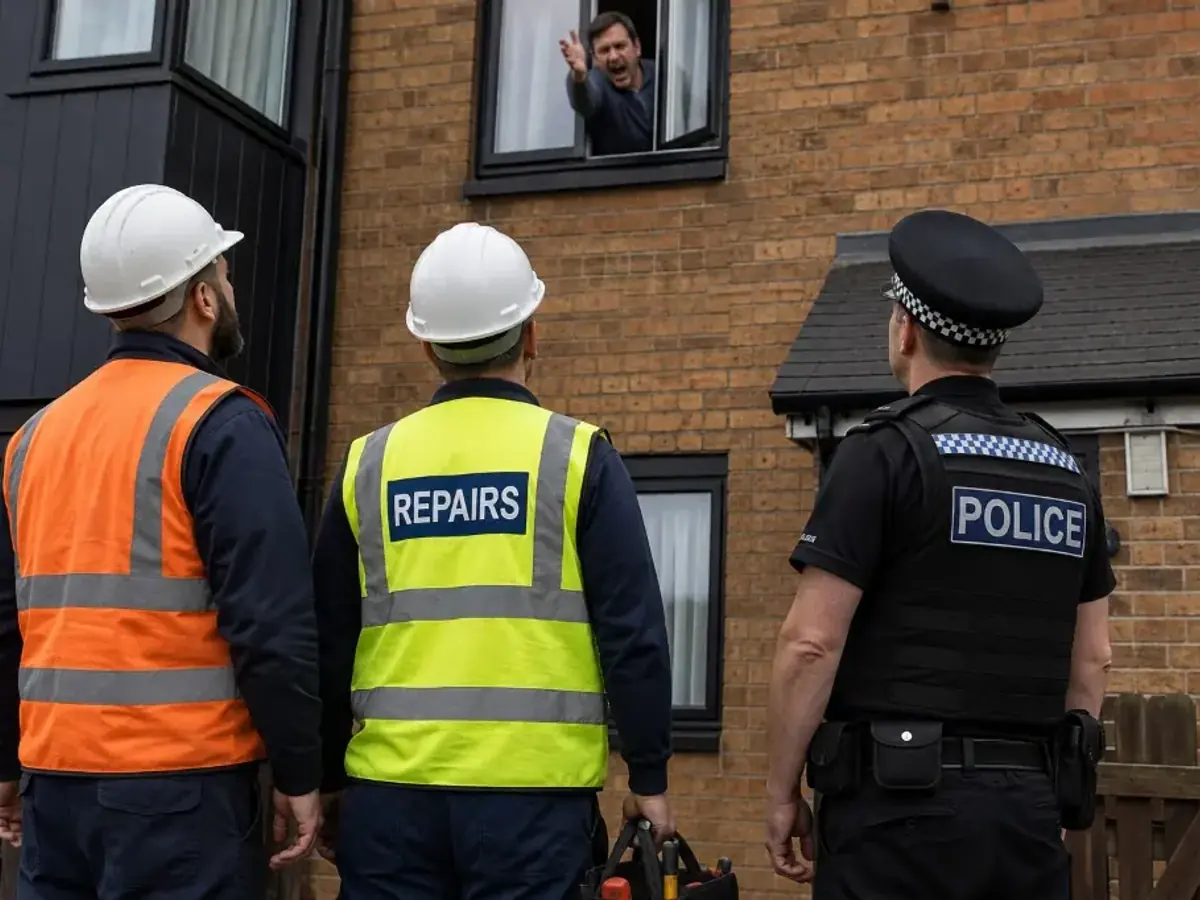
When responding to urgent repairs at marked or high-risk properties, housing providers must manage two legal duties at once. Staff safety now, and the housing-hazard repair clock. The visitor does not resolve that tension on the doorstep. The organisation must design the visit safely before anyone is sent.
Staff safety law (Great Britain)
- The Health and Safety at Work etc. Act 1974 and the Management of Health and Safety at Work Regulations 1999 are staff-safety law. Repair clocks do not cancel them.
- Regulation 3 requires a suitable and sufficient assessment. Regulation 8 covers serious and imminent danger: stop work, and do not resume while it persists except the regulation's exceptional cases. That statute sits behind withdrawal. It is not a two-person rule.
- If staff face detriment for leaving, or for refusing to return while the danger persists, the current right named here for Great Britain is the Employment Rights Act 1996, section 44. It applies in England, Wales and Scotland. It does not apply in Northern Ireland or Ireland. In Northern Ireland the equivalent is the Employment Rights (Northern Ireland) Order 1996 Article 68. Do not replace that with the Employment Rights Act 2025.
- The Worker Protection (Amendment of Equality Act 2010) Act 2023 is reasonable steps to prevent sexual harassment of workers. It is not a general violence or lone-working duty.
- Coming into forceEmployment Rights Act 2025 all reasonable steps and third-party harassment liability are planned for 30 October 2026. They are not current law.
Housing hazard and repair duties
- In Wales use the Renting Homes (Wales) Act 2016 sections 91, 92 and 97. Section 97 is a reasonable time after the landlord is aware. It is not a right to exclude the occupier into a hostile room, and it is not the English 2025 Regulations clocks.
- England only. Section 10A of the Landlord and Tenant Act 1985 (inserted by section 42 of the Social Housing (Regulation) Act 2023) implies a covenant in relevant social housing leases of dwellings in England that the lessor will comply with prescribed requirements for remedying hazards. The clocks sit in the Hazards in Social Housing (Prescribed Requirements) (England) Regulations 2025 (S.I. 2025/1042), made under sections 10A(3) and 10B of the Landlord and Tenant Act 1985. A prescribed hazard to health can drive a landlord repair clock. It does not apply in Wales. It does not authorise unsafe entry.
- For an emergency hazard, the investigation and the relevant safety work must both be completed within 24 hours of becoming aware, unless the official carve-outs apply. Phase 1 from 27 October 2025. Coming into forcePhase 2 from 30 November 2026 is not a current duty today.
Withdrawal can be the right outcome. A withdrawn job still needs an owned next step the same day. That next step is not “go back in”.
Housing law does not require the job finished that hour if staff cannot work safely. Health and safety law does not forbid all urgent visits at marked properties. Design the visit. See the legislation guide for statutes in more depth. This page is not legal advice.
Triage matrix
Safe visits are decided in the office before dispatch, not on the doorstep under pressure. Call handlers and repairs planners should run marked properties through a structured triage. The levels below are a planning aid. They are not a statute and they are not a default two-person rule.
| Risk level | Example triggers | Planned controls |
|---|---|---|
| Level 1: low or standard | Routine repair marker. No history of physical threats or aggression. | Standard solo visit with a personal safety device enabled, if that is the assessed control. |
| Level 2: moderate | Verbal abuse history, anti-social behaviour markers, or unsecured dogs on site. | Two-person team (operative plus supervisor or housing officer), or a pre-agreed dog containment check. See dangerous dogs awareness. |
| Level 3: severe | Threats of violence, weapons history, recent assault, or active police interest. | No solo entry. Managed joint visit with an anti-social behaviour or housing lead. Pre-visit risk review before dispatch. |
| Level 4: critical | Active hostile siege, acute mental health crisis with a weapon, or an active threat to life. | Immediate pause. Do not dispatch trade staff. Coordinate the emergency response through the police or crisis services. |
That is not a universal buddy rule. The Health and Safety Executive extra-person list is high-risk technical work. It is not a default second person for every marked visit.
Before the van leaves
Before assigning or dispatching an urgent job to a marked property, check the following:
- System markers. Review historical flags, withdrawal records, anti-social behaviour reports, and known environmental risks such as dangerous dogs or weapons history.
- Job scope. Establish whether the emergency repair can be isolated or completed from outside the main living area, such as an external stopcock or meter box.
- Planned controls. If the risk assessment requires a two-person visit, a supervisor, or a housing officer, do not dispatch a lone operative. A second person must have a defined role, such as managing communication. They must not act as a passive bystander.
- Visit ownership. Name the visit owner. The operative carrying out the repair is not the visit owner. Confirm who may delay, change or stop the job.
See dangerous dogs awareness and the Lone Worker Safety Centre for those controls. Do not turn this page into a dogs or lone-working manual.
Personal safety devices can support the plan. They do not replace it. See lone worker personal safety devices.
On arrival
Use dynamic risk assessment before leaving the vehicle or approaching the entrance.
Doorstep go or no-go checklist
- Environmental scan. Is the exit pathway clear and unobstructed?
- Occupant demeanour. Is the occupant calm enough to receive a brief explanation of the work?
- Substance check. Are there visible signs of acute intoxication, drug use, or unpredictable agitation?
- Bystander risk. Are unaccounted or hostile people present inside the property?
- Animal control. Are all dogs fully secured in a separate room with a closed, latched door before entry?
If any single doorstep check fails, halt entry. Step back to the vehicle. Contact the visit owner at once. Do not test whether a historical marker was overstated. A step back, a pause or leaving is enough.
- Do not block someone in a room. Staff must not close a person in to finish a job.
- Prefer postpone, a managed space, or a conversation away from the work area with exits clear.
- If that is not agreed, withdraw.
- Record what happened. Escalate to the visit owner.
Who speaks, who works
This split is Safety Solutions Training Ltd interpretation. It is not a statute.
If the visit proceeds, keep technical work separate from conflict management:
- The person doing the work should not also manage the occupant's anger, anti-social behaviour or an access dispute.
- Communication sits with a named officer or supervisor who is actually there.
- If that person is not there, redesign the job.
- Do not leave the worker to keep them talking while they work.
Electrical work
- Electrical work sits under the Electricity at Work Regulations 1989.
- Isolation needs competence. Prove dead.
- Isolation from outside the living space is Safety Solutions Training Ltd interpretation only where it is lawful, competent and accessible.
- It is not punitive. It is not a duty to isolate.
- This page does not give a gas isolation method.
- Operatives must not attempt delicate isolations while subjected to ongoing verbal hostility.
Withdrawal
If conditions deteriorate on site, staff must execute a planned withdrawal without delay under Regulation 8 of the Management of Health and Safety at Work Regulations 1999 and, in Great Britain, section 44 of the Employment Rights Act 1996.
- Immediate withdrawal triggers. Verbal threats, brandishing objects, blocking exit routes, or releasing unhandled animals require immediate disengagement.
- Withdrawal protocol. Disengage calmly. Leave the property at once. Return to a secure vehicle or a safe location.
- Multi-agency boundaries. Police attendance is reserved for preventing a breach of the peace or responding to a crime. Do not rely on police officers to stand over routine housing repairs.
Police and mental health
- Wales
- Welsh police, and police community support officers where the force uses them. 999.
- England
- police and police community support officers. 999.
- Scotland
- Police Scotland. 999. Not PCSO.
- Northern Ireland
- Police Service of Northern Ireland. 999. Not PCSO.
- Ireland
- An Garda Síochána. 999 or 112. Not UK police.
- Other police or community officer attendance is requested, not guaranteed.
- Call 999 for immediate danger or a crime in progress. In Ireland that is 999 or 112.
- Right Care, Right Person is an operating model used by some forces in England and Wales. It is not a statute. It does not make police attendance automatic.
Blocked access
- Stop. Record the facts. Pass the job to the named legal or neighbourhood owner.
- Do not tell a worker to force a door.
- In Wales, access for works under the Renting Homes (Wales) Act 2016 sections 91, 92 and 97 is at a reasonable time after the landlord is aware. Emergency access under the Renting Homes (Supplementary Provisions) (Wales) Regulations 2022 is to the dwelling. It is not force against the person.
- Crime and Policing Act 2026 housing injunctions are not in force. Do not treat them as a live duty. If a court route is needed, that is a hand-off to the named legal owner under the Anti-social Behaviour, Crime and Policing Act 2014 Part 1. Occupation-contract access terms are housing law, not a staff-safety procedure. Do not treat injunctions as the visiting playbook.
After the visit
A withdrawal is a valid safety outcome. The underlying housing hazard still needs an owned next step the same day. “Go back in” is not a valid next step.
Make people safe first. See post-incident support for welfare after a distressing visit. Do not send the same lone worker back because the leak is worse, without a new plan.
Record facts only:
- what was planned
- what changed
- what was decided
- who was told
- what happens next, and who owns it
This is not a court-evidence manual. Housing systems can use a standard log of this kind:
[URGENT REPAIR WITHDRAWAL REPORT]

1. VISIT DETAILS
   - Date and time:
   - Property address:
   - Job reference and hazard type:
   - Staff present (names and roles):

2. REASON FOR WITHDRAWAL (objective facts and observed behaviour only)
   - Specific behaviour or hazard (for example, occupant shouted, held a glass bottle, and blocked the hallway):
   - Animal issues (if applicable):
   - Environmental factors:

3. IMMEDIATE ACTIONS TAKEN
   - Time exited property:
   - Safe location reached:
   - Visit owner or line manager notified (time and name):

4. HAZARD CONTAINMENT STATUS
   - Has the emergency hazard been isolated externally? (Yes / No / Partial):
   - Immediate risk to neighbouring properties (for example, active water leak or gas smell):

5. OWNED NEXT STEP (to be completed by the housing manager within 2 hours)
   - Assigned action owner:
   - Alternative access plan, temporary rehousing, or legal injunction status:
Related training
Practise communication, withdrawal and reporting in Conflict Management on housing association visits. A course does not replace the visit plan, withdrawal authority, or an owned next step after a job is stopped.
Official sources used for this page
- Health and Safety at Work etc. Act 1974 opens in a new tab
- Management of Health and Safety at Work Regulations 1999, regulation 3 opens in a new tab
- Management of Health and Safety at Work Regulations 1999, regulation 8 opens in a new tab
- Employment Rights Act 1996, section 44 opens in a new tab
- Employment Rights (Northern Ireland) Order 1996, Article 68 opens in a new tab
- Electricity at Work Regulations 1989 opens in a new tab
- Renting Homes (Wales) Act 2016, section 91 opens in a new tab
- Renting Homes (Wales) Act 2016, section 92 opens in a new tab
- Renting Homes (Wales) Act 2016, section 97 opens in a new tab
- The Renting Homes (Supplementary Provisions) (Wales) Regulations 2022 opens in a new tab
- Landlord and Tenant Act 1985, section 10A opens in a new tab
- Landlord and Tenant Act 1985, section 10B opens in a new tab
- Social Housing (Regulation) Act 2023, section 42 opens in a new tab
- The Hazards in Social Housing (Prescribed Requirements) (England) Regulations 2025 opens in a new tab
- Health and Safety Executive: Violence and aggression at work opens in a new tab
- Health and Safety Executive: Protecting lone workers opens in a new tab
Published 3 September 2026. Updated 4 September 2026.
This page is guidance from Safety Solutions Training Ltd. It is not legal advice. Safety Solutions Training Ltd is not a solicitor and does not act as your lawyer.
It is not a substitute for your organisation's own procedures, risk assessment or competent advice on your facts. It does not decide liability in a particular case.
The law changes. A source-check date is not a promise that every later change has been caught. On the day you rely on this page, check the named statute, regulations and official sources. For UK law, start with legislation.gov.uk. For the Republic of Ireland, start with the Irish revised Acts. Follow the regulator named on this page.
Duties on this page apply only in the nations named here. Do not copy England or Wales wording onto Scotland, Northern Ireland or Ireland unless this page says that duty extends there.
Source check 3 September 2026. Next review 28 October 2026, or sooner if the named official sources change. Not legal advice.
Safety Hub
Practical insight and resources built from thirty years at the frontline.
Workplace violence and aggression
Practical controls for violence, aggression, conflict, reporting and review.
Lone Worker Safety Centre
Guidance for staff who work alone, visit, travel, or need check-in and escalation.
Managing challenging phone calls
Abusive calls, repeated contact, boundary setting, records and escalation.
Notice, record and refer
What non-specialist staff should notice, record in fact, and refer.
Recognising boundary drift
Gifts, over-familiarity, unofficial contact and pressure to bend the rules.
Dog risk for visiting staff
What to check before a visit, and what to do if a dog is present.
Why live practice matters
How scenario practice tests real workplace decisions without theatrical conflict.
Personal safety away from the workplace
Travel, walking and public transport. Written for employers to share with staff.
Plan training around your staff and risks
Tell us about your staff roles, working environment and the situations your staff face. We will recommend the right training approach for your organisation.
Trusted by organisations across the UK for practical, scenario-led staff safety training.